The Big Field Trip

The Big Field Trip header image 4

Rice and Shrimp Farming

April 12th, 2010 by Cyrus
Respond

Shrimp and rice farming has been part of Asia’s culture for a long time. They both are very popular in Vietnam. Vietnam is one of the world’s leading exporters of both rice and shrimp. Rice farming is a lot older than shrimp farming, but they both started in Asia.
Rice Farming in Vietnam
Rice farming started over 4000 years ago. Rice was first domesticated in the Yangtze Valley, which is in China. Rice is the staple food for over half of the world’s population.
Vietnam is the world’s second largest exporter of rice, behind Thailand. Most of the rice in Vietnam is farmed in the North and the South because the center of the country is very narrow and mountainous, while the North and the South have river deltas. In Vietnam, 75% of the cultivated land is planted in rice. In the North there are usually two rice crops planted per year; in the South there are three because it rains more in the South.

From The Big Field Trip – Vietnam, March 2010


Rice can be used in lots of different ways. The average Vietnamese eats ¾ pound of rice per day in the form of plain rice, noodles, dumplings, rice paper, etc. The stalks of the rice are used to thatch roofs and to make sandals, hats and baskets; the husks are used to make charcoal. No parts of the rice plant are wasted.
Almost all rice is grown in the same way. It is grown from the seed in nurseries for 25-50 days. After that period, they are sold to farmers, who plant the crops in shallow ponds called paddies. The farmers wait until the rice plants’ leaves turn yellow, and then they drain the paddies. They harvest the plants with sickles and knives. The farmers wrap the rice in bundles and leave them in the paddies to dry for a few days. If the rice still isn’t dry, the farmers may lay the rice out on the highway to dry. After the rice is dry, they put it through a machine to separate rice kernels from the husks. These machines are usually owned by the community. After the machine has done its work, the rice has to be threshed. This means that the rice is put into a basket and tossed into the air. The aim is for the husks to be blown away in the breeze and the rice kernels to fall back into the basket. Threshing is usually done by women or girls, and it’s harder than it sounds. Then the rice is ready to eat or sell.

From The Big Field Trip – Vietnam, March 2010

When farming rice, people aren’t the only animals used in farming. People use water buffalo not tractors, which get stuck in mud, to plow the fields. There are sometimes lots of scarecrows in some fields, just cloth hung on sticks, to keep the birds away. I also saw another interesting technique to keep birds away, someone had hung a net in a garden, and so if a bird flew into the garden, it would get stuck in the net. Sometimes people raise ducks in rice fields. The ducks fertilize the rice plants with their droppings. They also eat the weeds and insects from around the rice plants.
There are two different types of rice farming in Vietnam: dry rice farming and wet rice farming. Wet rice farming is more popular in Vietnam. Dry rice farming is practiced in places where it is not flat, like on mountain slopes or in steep valleys, it is fed by seasonal rains. Dry rice doesn’t require much work, but doesn’t yield much crop.

From The Big Field Trip – Vietnam, March 2010

Shrimp Farming in Vietnam
Shrimp farming started in Asia in 1500 A.D., but has spread all over the world. Large scale shrimp farming didn’t start until 1900’s, when the demand was high and it made sense to farm it because it’s very expensive to farm shrimp. Most of the shrimp before the 1900’s was caught wild from the ocean. Now there are shrimp farms all over Vietnam.
Vietnam is the world’s third largest shrimp exporter, behind the United States and Thailand. Over 2 million people have jobs in Vietnam’s shrimp farming industry. In 2003 the US imported 588 million dollars worth of shrimp from Vietnam. 75% of farmed shrimp is farmed in Asia, and the other 25% is farmed in the Americas, especially in the US and Brazil.
There are two main species of shrimp farmed in Vietnam: the classic white shrimp and the giant tiger prawn. The shrimp are grown from eggs in nurseries for a period of 12 days then are bought by farmers. Farmers put the shrimp in either large tanks or ponds. The ponds are traditionally 1.5 or more meters deep (4-5 feet). After about 25 days, when the shrimps’ gills branch, they are moved to another pond. They are in the grow-out ponds for about 3-6 months (depending on the species and place they are farmed). When they are ready to harvest, the shrimp are either caught in nets or traps.
Extensive shrimp farms are found along the coast where the real estate is cheap. Extensive shrimp ponds cover a lot of space, sometimes covering a square kilometer. In these ponds there aren’t many shrimp per square meter. The farmers don’t feed the shrimp; the shrimp feed on things they find naturally in the water. Extensive shrimp farms aren’t as expensive to run, but they aren’t as profitable.
Intensive shrimp farmers usually use smaller ponds with more shrimp per square meter. They put aerators in the ponds so there is more oxygen in the pools, and the aerator’s propellers go about one meter deep. Intensive farmers have to feed the shrimp krill that have been fed antibiotics because disease can spread easily in the cramped ponds. They also feed them powdered fish. In intensive farms, they have to pump in clean water all the time. Intensive farms are a lot more expensive to run because they require so much energy, materials, and labor. Intensive shrimp farms can be very profitable, but they are more expensive than extensive shrimp farms. They make more sense in areas where real estate is expensive.


From The Big Field Trip – Vietnam, March 2010

Since intensive shrimp farmers pump lots of water in and out of their shrimp ponds, disease can spread quickly from farm to farm. Some shrimp diseases intensive farmers try to protect their shrimp against are yellow head disease and white spot syndrome. Yellow head disease is highly contagious with mass mortality within two to four days. The infected shrimp get a yellow head before dying. White spot syndrome is a highly lethal disease and has a 100% mortality rate. Before dying, the shrimp’s digestive tract turns red, and they get white spots on their head.
Farming shrimp can be risky, not only because of disease, but because of an entire crop can be lost in a flood. When we were touring shrimp farms around Hoi An, our guide told us that a recent flood rose over the walls of the shrimp ponds. The shrimp were washed downstream. Some were caught by lucky fishermen, but the farmers lost everything. Many shrimp farmers started farming rice instead of shrimp. Rice farmers earn less profit, but rice farming is not as risky.

From The Big Field Trip – Vietnam, March 2010

Shrimp farming can have a negative impact on the environment, so governments are beginning to regulate shrimp farms. In the recent past, many Vietnamese shrimp farmers were creating salt water ponds inland. When the shrimp farmers pumped their salty waste water into rivers and canals, it mixed with the fresh water that other farmers used for watering their crops. The salt water killed the crops. It is now illegal to farm shrimp inland in Vietnam.
Extensive farmers have cut down a lot of coastal trees, especially mangrove forests, which were seen as land with little value. Now we know that mangroves can stop erosion from floods and devastating storms like typhoons. Mangroves are also a natural nursery for fish and shrimp. The fishermen suffer reduced catches when mangroves are cut down. Now shrimp farmers are encouraged to replant mangroves along and inside their shrimp farms. When we visited Cat Ba Island, in Ha Long Bay, we saw shrimp farmers planting mangroves in their farms. A few years before their farms had been wiped out by a typhoon. Now the farmers are building eco-friendly shrimp farms in mangroves. In the future, I hope that all farmers will create shrimp farms that are actually good for the environment.

From The Big Field Trip – Vietnam, March 2010

Shrimp and rice are used in many dishes of Vietnamese cuisine. Shrimp is used to add a little flavor to bland food. Rice is used in almost every meal, usually more than once. Vietnam is very fortunate. Its geography, climate, river deltas, rainfall and coastline do make it one of the world’s biggest (for its size) food producing countries. Many countries can’t feed their own population; much less feed others as well. With the world population rising so fast, the rest of the world depends on Vietnam’s harvests of rice and shrimp.

Tags: No Comments.

Vietnam Adventures

April 5th, 2010 by Isabella
Respond

From The Big Field Trip – Vietnam, March 2010

The rain makes pddddd sound as it sploshes against the window of the taxi

Schhhhhhhhh goes a bike on the wet road

A white stone dragon creeps on the roof of a pagoda

Water drips from its beard

The Perfume River fills up with muddy water

That streams from the hillside

Looking through the foggy window

I see a lonely watermelon sitting on a board

Raindrops bead on its green veined surface

I wrap my jacket tightly around me

It’s a rainy day in Hue

From The Big Field Trip – Vietnam, March 2010

Chairs creak as the audience settles themselves in the chairs

The performance starts with plucking strings

Doing! Doin! Doi!

A ripple of water spreads as a puppet comes from behind a very thin piece of cloth

The hidden puppeteers move the puppets with rods that are under water

Four dragons swirl figure eights while spitting water out of their mouths

The water sloshes and jumps

The drum beats loudly

Grandpa slumps against my shoulder

He’s tired because he hasn’t slept for days

The dark theater surrounds us

We are at a water puppet show

From The Big Field Trip – Vietnam, March 2010


Up the stairs we go – into the moss-covered jungle

Don’t step off the path! There are land mines out there from the Vietnamese-American War

Grandpa spots a tiny white gecko on a big green leaf

I spot red-headed lizard on the slippery steps

We walk down the path to a river

Mom throws my ball into the waterfall

I jump off the slippery rocks into the crystal clear water 

The deep pool is 12 feet deep – Papa can’t even touch the bottom!

Little sucker fishes clean the pool

The air is sweltering as we trudge up the back up the stairs

Cruz spots a small grey and white moth blended into tree bark

An earthworm falls from the tree tops on to a bed of leaves, right in front of Grandpa

The earthworms in this jungle are supposed to cure malaria

Calling for mates, cicadas whine like fire trucks

I hear the honking of the car horn – our driver is telling us to hurry up

We are in Bach Ma National Park

From The Big Field Trip – Vietnam, March 2010

I am sea-sick, tottering on our floating junk

As the anchor lifts, the junk sways in the wind

We curve around the islands, and it reminds me of the floating mountains in Avatar

Rocks balance on the side of cliffs and they look like they’re going to fall off any second

The drizzling rain makes me shiver

Cy jumps off the junk into the icy-cold water

Fisherman bring up traps full of fish and crabs

A dried-out jellyfish lies on the sand like a plastic grocery bag

As we climb to the cave, I begin to count steps

The top of the cave looks like sand dunes in the Sahara Desert

The cave lights blink as I count 777 steps

Back in the light, we can see the islands sticking out of the green painted sea

We are in Ha Long Bay

Tags:   · 3 Comments

Bugaria Slideshow

April 1st, 2010 by Cyrus
Respond

Bulgaria Slideshow from Jason Kirkman on Vimeo.

This is our slideshow from Bulgaria.

Tags: 2 Comments

Animals and People in Thailand

March 24th, 2010 by Isabella
Respond

From The Big Field Trip – Thailand, February 2010

My family and I just visited Thailand for two weeks. It was a lot different from India because they treat animals a lot differently. Thais keep many different kinds of animals as pets. Some of them are captured from the wild and some of them are bred just to be sold as pets. Thai people kill and eat almost every type of animal. But animals also eat people and give them diseases. There are lots of different relationships between people and animals in Thailand.

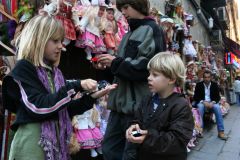
Thai people eat the meat from all kinds of animals. The first night we were in Bangkok, we ate at a street kitchen with plastic chairs and tables for people to sit on. They served us steaming bowls of rice noodle soup with slices of pork and fish balls. There were cockroaches under our feet eating the rice noodles that fell from our bowls. A few days later we walked down the same block where we ate the first night, and we saw a man selling fried cockroaches, frogs, grasshoppers, and maggots. People grill meat on skewers like chicken, beef, pork, and shrimp. (Fact: Thailand is the country that exports the most farm-raised shrimp in the world!) They even grill chicken livers and chicken tails. When I went to the beach in Ko Samet, I saw a vendor selling flat squid with writing on it. The man had a grill to cook the squid. He also had a machine to flatten the squid. When he flattened the squid, it looked like cardboard because of the ridges in it. All of the squid he flattened was hanging from a cart that he was pushing. As I walked down the beach I saw a restaurant with a display table out front. It was full of shrimp, squid, crab, fish, horseshoe crab, cockles, and clams. The people in Thailand eat everything!

From The Big Field Trip – Thailand, February 2010

In Thailand, many animals carry sicknesses. Many dogs in Thailand have rabies. If there are 1000 dogs, about 100 of them will have rabies. If a dog with rabies bites a person, then the person could get rabies. Then they would have to get shots in their belly. Ouch! My mom and dad were very scared about the rabies, and did not let us get near any animals that lived on the streets. Every time the sun went down, we had to put mosquito repellent on because there are diseases that mosquitoes carry such as Japanese encephalitis and malaria. Luckily there are geckos on the walls of every single home. The geckoes eat insects (and maybe even mosquitoes). People are very glad to share their homes with the geckoes.

We went to a market called Chatuchak Market, and we saw a lot of different animals for sale as pets. Some of them were endangered. The pet market was huge. It could have taken up 10 city blocks! People shoved their way through aisles full of squawking parakeets in wire cages, lizards climbing fake branches, crocodiles in glass tanks, fish in coral filled aquariums, monkeys in plastic pens, and flying squirrels with collars and leashes to prevent them from escaping. There were kittens mewing, puppies yapping, hamsters sniffing, and rabbits eating pellets. Many of the animals were for feeding other animals. Tiny mice were food for snakes, crickets were for the tarantulas, and beetle larva was for the lizards. There was a clothing store for pets. It sold teeny little skirts for Chihuahuas. Thais are crazy for their pets.

From The Big Field Trip – Thailand, February 2010

I enjoyed going to the pet market because there were lots of different animals that I had never seen. It was like going to a zoo. Some of the animals were captured from the wild, but most of the animals were bred to be sold as pets. It is a good thing when a person buys a pet and takes care of it, but if you buy an endangered animal, the person who sells it will be more eager to catch more and put them in the market to sell. If this happens the endangered species cannot breed, and if more are caught from the wild, they will go extinct. People should not buy endangered animals like jungle birds.

Visiting Thailand was fun. There was lots of good food to eat. There was also a lot of animals to see, mostly pets in the market and on the street.

Tags: 7 Comments

The Kavita School

March 12th, 2010 by Cyrus
Respond

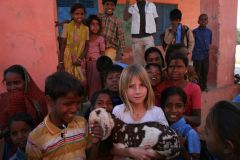
My family and I started teaching at a small public school in India at the end of January, 2010. We taught 1st and 2nd graders in the school for three weeks. We started teaching at the school after we met Maneesh in our small town of Badgaon, India; he is my friend’s cousin. Maneesh lives in Bombay, but he was in Badgaon visiting his family. Maneesh created an NGO (like a non-profit organization) and wants foreigners to come teach English in tribal villages. The school where we taught was in a teeny tiny village called Kavita, so we called it the Kavita School. Most of the people there were very poor; some earned less than a dollar per day. Many of the kids had health problems, like worms and infected cuts. Most of the people in Kavita are farmers from the Bihl tribe, but Bilh people were traditionally hunters. They are some of the best archers in the world and are also great singers.

From The Big Field Trip – India, 2010

When we first went to they Kavita school, all of the kids were afraid of us. When my dad tried to help a student named Arjuna (pronounced Ar-june) with his math, Arjuna shrank away from him, nodding at everything he said. But a week later Arjuna was answering many questions and playing games with no fear. The students really enjoyed playing outdoor games that we taught them; it helped to “break the ice.” It took a while for the kids to warm up to us, but they did eventually.

We had about 30 kids in our class; it varied day to day because only about ¼ of the kids in the community came to school everyday. We did lessons on math and English. We also played games with the students. I was surprised about how little they knew, but how fast they learned. Most of the second graders didn’t know how to add numbers together. There was one genius who could add numbers together in his head and say it in English.

From The Big Field Trip – India, 2010

A normal day for me in India went like this: First I woke up at 8:30, started homeschooling at nine o’clock and studied until 1:00, when my family and I had lunch. My dad would have planned the lessons for Kavita earlier that day. We would all pack the supplies for the school, and when we heard the auto-rickshaw’s tuk-tuk-tuking along our road, we would run out of our house and jump in. On Tuesdays and Thursdays my mom and my little brother, Cruz, did not go to the Kavita School. After stopping at a fruit stand where we either bought 100 guavas, oranges, or bananas for the students, we drove 20 minutes to Kavita. When we got into the village, at about 2:00 pm, kids in blue uniforms came out of their houses and ran after us until we got to the school. I’d say about 30% of the kids in our classroom just came to school when we were there; they didn’t come in the morning.

When we got into the classroom, which was empty of desks and chairs for students, there would be about 50 students sitting on the floor of the room. Two teachers would come in to remove students that weren’t in first or second grade. They had to threaten the children with sticks, because they really wanted to be part of the class. Apparently it’s ok for teachers in India to hit students. We would first send our students to go wash their hands. I had to guard the door so that only our students got back in. Then we greeted the students with a hello and a good-afternoon.” Then I counted all the students in English (me: one, students: one, me: two, students: two, me: three, students: twee etc.). After counting, my mom would sing the ABCs with the students. Then we would either teach them a song or practice one we’ve all ready taught to the (like the Hokey Pokey and the Itsy Bitsy Spider). Meanwhile I drew a scene of the school with lots of doors, windows, people, trees and animals. Then my dad would ask “how many _____?” (i.e. how many students?).

From The Big Field Trip – India, 2010

After that we would split off into four groups, one for each member of my family, except Cruz, who participated as a student. I played memory with the students, my dad taught math, Bella played UNO or other card games and my mom drew pictures of objects with the students and taught them the name of the objects in English. We switched groups every 15 minutes, so groups lasted for about an hour. After the four groups we went outside for a game. We played games like duck-duck-goose and Simon Says. These games lasted for about 20-30 minutes; we played with the whole school, there were about 90 kids. Then we passed out the fruit to all the students. At this time it was about 4:00. We then took the tuk-tuk (auto-rickshaw) back to our house. For the rest of the day I played cricket with the kids in the neighborhood until the night time, when I did my homework.

From The Big Field Trip – India, 2010

Communication with the students wasn’t a big problem because we had a translator to help us. His name was Pinu; he volunteered each day to help us teach the students. He translated everything we said into Hindi. The students first language is Marwar, but all of them spoke some Hindi. We also learned a few Hindi words like “chup”, which means quiet, and “suno”, which means listen. On our first day, Maneesh, the man who ran the project, was our translator. Maneesh created a NGO, a project that enabled foreigners to come teach at the schools. He thinks it will be a good experience for the kids because they would come to school more, because whenever we came to the school, the attendance doubled.

On our last day teaching at the Kavita School, a doctor came to check the student’s hygiene. We had a regular school day except it was twice as long as it usually was, four hours. Every half hour the doctor would come in and take another group of students. The last day was sort of sad, but also fun. We (Bella, the students and I) played lots of games that day, like duck-duck-goose, Spider’s web and Steal the Bacon, while my parents clipped dirty fingernails. By the end of the day, all the kids had clean, clipped nails and were clean. We had prepared bags for them the day before, 100 of them, one for each student. Each bag had a toothbrush and toothpaste, a box of pencils, a sharpener, an eraser, crayons, and notebooks (for school), a bag of peanuts (for nutrition), a guava and an orange (for vitamins), a bar of soap and a photo to remember us by.

This experience has changed my way of thinking, I understand how simply people can live. I really enjoyed teaching; I hope many people can teach the kids in Kavita in the future, teaching was a great experience for me and the students.

From The Big Field Trip – India, 2010

Tags: 5 Comments

February 24th, 2010 by Cyrus
Respond

The world has many religions. From Sikhism to Judaism, many different religions are practiced world wide. People follow religions because they explain creation, why we are here on earth and what happens when we die. Religions also give people hope, through prayer, and mark rites of passage, which are rituals that help people see themselves differently as they enter new phases of their lives. Each religion has special holy people who carry on traditions and are spiritual leaders who give advice to people. Religions list rules for dealing with family, neighbors and strangers or enemies. Even though there are many differences between religions, there are many similarities. On my trip around the world, I have met people from many different faiths. They have taught me to understand and respect their beliefs.

Hinduism is a polytheistic religion. There are many gods like Ganesh, an elephant headed god and the remover of obstacles; Shiva, the god of destruction; Brahma, the god of creation; and Vishnu, the god of preservation.  On February 12th, I celebrated Shivaratri in India. Shivaratri is a day on the Hindu calendar, set aside to honor lord Shiva. I went to a Shiva temple on Shivaratri; it was in an underground cave. The smell of incense was intoxicating. Humid air filled the underground room. One by one, people kneeled in front of an altar depicting lord Shiva. One man painted a tilak, a streak of red paint, on each worshiper’s forehead. As I was leaving the cave, the priest handed me some sweets made from milk and sugar.

From The Big Field Trip – India, December, 2009

Unlike most religions, Hinduism doesn’t have a founder or one holy book, but it has many important scriptures. The Vedas are different chants and discussions from 1500 BC. They were written down in 1000 AD. Before they were written down they were passed on by memorizing and retelling.

Hindus worship gods in shrines, temples or at home. In India, there are many shrines on the sides of the roads. Brahmins are the highest caste in India. They worship Brahma; Brahmins are the priest class of the Hindu religion. Brahmin priests lead the ceremonies at weddings and give spiritual guidance to the people in their community. I have many friends in India who are Brahmin, but in modern India anyone can do any job regardless of their caste. My friends’ fathers are business men and teachers.

From The Big Field Trip – India, 2010

My freind Sonu,. He’s in the yellow, black and grey shirt.

Sadhus are holy men of the Hindu religion. They travel from town to town asking for food. They are of the Brahmin caste, and have given up all luxuries to worship Lord Shiva. They are easily recognizable in a crowd because they wear orange robes, carry begging bowls, and have painted eyes or three stripes on their forehead. Tridents are a sign of Shiva, and Lord Shiva has three eyes, two regular eyes and one eye of destruction. When opened, the eye turns everything in its path to ashes. Brahma, the god of creation, had five heads, but now he only has four because Shiva fried his head off.

Hindus believe in reincarnation. Reincarnation means that when you die, your soul goes into another living creature that was born the moment you died. Then when that creature dies, your soul goes into another creature, and on and on like that. Hindu’s believe in karma. There is good karma and bad karma. To get good karma you do good things like worshiping the gods, helping people, and following your duties. When a person dies, if they have good karma they go to heaven and become gods. If a person has bad karma they may be reincarnated as an animal. If they have balanced karma they are reincarnated as a human again, and if they have really bad karma they go to hell. In the Hindu tradition, when you die you’re cremated. Hindus believe that spreading someone’s ashes in the Ganges River ensures that the person will go to heaven.

In World War II, Hitler used the swastika, the Hindu sign for good luck, as the symbol of the Nazi party, except it was turned around backward. In India it means good luck. Hindus usually have it on the door their homes and the entrance to weddings.  Most Hindus have shrines in their home that contain statues or pictures of gods. Ganesh is the most popular god; almost every Hindu has a statue of him in their house. He is the remover of obstacles, and he brings good luck. Even now, as I walk down the streets of Bangkok, which is Buddhist, I see statues of Ganesh with offerings like fountain drinks, money, and sweets placed around him. Even the Thais believe that Ganesh has the power to solve their problems and bring happiness to their lives.

            Sikhism is a small religion found in India. You can easily distinguish Sikhs in a crowd. All Sikh men and boys over thirteen wear turbans, so you can easily identify them. It is against the Sikh religion to cut your hair, although many Sikhs do. Five things Sikhs must do are: 1) Be clean 2) Commit good deeds 3) Protect their families 4) Not cut their hair and 5) Have self-discipline. Sikh means disciple.

            The most important Sikh site is the Golden Temple in Amritsar, India. Sikhs give gold to the temple, which is put on the temple’s domes. I haven’t been there, but from the pictures I have seen, the Golden Temple shines like the sun. Sikhs worship their god, Mool Mantar, in gurdaws, which are temples. The religious leaders in Sikhism are called gurus. The religion was founded by Guru Nanak, who was born in Lahore, which is now in Pakistan. He taught that god is in everyone. Guru Nanak wrote his ideas in the Guru Granath Sahib, which is the Sikh holy book.

From The Big Field Trip – India, December, 2009

Although Sikhs believe in reincarnation like Hindus, Guru Nanak didn’t believe in the caste system and thought that it was ridiculous to worship icons and give offerings to the gods. Sikhs also do not believe in fasting and superstitions. They believe that you should do actual deeds like give to the poor and stand up against injustice. When we were in Delhi, we took a tour of the city to see how street kids lived. Our guide was a former homeless kid. He told us that no one starves in Delhi because of the Sikhs. Anyone can go to a Sikh temple and eat there. Sikhs cook food and sit and eat with some of the poorest people in India. They believe that all people should be treated equally, from the dirtiest street sweeper to the King of Japan. Sikhs also aren’t supposed to drink alcohol, take drugs, or smoke.

Sikhs believe they are holy warriors, fighting against injustice. Sikh men are supposed to be courageous, strong, and fierce. A great example of this was our Sikh driver, Mr. Singh, on our tour of Rajasthan.  Whenever there was a traffic jam, he got out of the van and scowled at everyone. They sure got out of there fast. Mr. Singh told us that he gives 10-20% of his earnings to the temple to feed poor people and help those in need.

From The Big Field Trip – India, December, 2009

Judaism is one of the world’s oldest and spread out religions. The only place where Judaism is a majority is Israel. It is practiced most in the Middle East, Europe, and the United States. People who practice Judaism are called Jews. The original Jewish language is Hebrew. Judaism was founded in 1300 BC in Mesopotamia. The founder of Judaism was Abraham. God told him to leave Mesopotamia and go to a holy land, where he would be the founder of a nation. The holy land is now Israel and Abraham’s people are the Jews.

Jews worship their god (the same god as in Christianity and Islam) in synagogues. The Jewish holy men are called rabbis. Some Jewish holidays are Passover and Hanukkah. Jews cannot eat animals with a split hoof like pigs, or with paws like rabbits. Jews can only eat fish whose scales and fins can come off. According to traditional Jewish Law, a Jew is “anyone born of a Jewish mother” or converted to Judaism in accord with Jewish Law. Most Jewish men and boys wear “kippahs”, skull caps, which are tiny black hats.

The Star of David is one of the symbols of Judaism. A popular Jewish folk tale says that the Star of David is made after the shield of the Israelite warrior, David, who would later become King David. To save metal, the shield was made of leather stretched across a simple metal frame of two interlocking equilateral triangles that would hold the round shield.

From The Big Field Trip – Istanbul, November 2009

In Turkey, we had a Turkish teacher named Alper. He was a Jew whose ancestors were from Spain. When the Muslums ruled Spain, Muslims, Christians, and Jews could practice their religion freely. When the Christians came and took over in 1492, they told the people who weren’t Christian to either convert to Christianity or leave. Some people agreed to convert, but secretly followed their religion, some left Spain, and some did neither and were tourtered until they converted or died. Most of the Muslims who left Spain went to Northern Africa, many of them settling in Tunisia.  Alper’s Jewish ansestores fled from Spain and went to Turkey, which was part of the Ottoman Empire. Under the Ottoman Empire, anyone can practice their religion. Alper still spoke a little of the old, medival Spanish from that time!

Islam is one of the world’s largest religions. People who practice Islam are known as Muslims. Islam was founded by Muhammad. Muhammad spoke the words of God. His followers wrote his words in the Koran, the Muslim holy book, so they would not forget. Since, the verses of the Koran came directly from the Muslim god, Allah, Muslims consider the Koran very holy. One cannot even touch the pages of the Koran. You have to use a special tool to turn the pages. Since Allah spoke Arabic to Muhammad, Arabic is considered a holy language, and Muslims are expected to know the lines of the Koran in Arabic. Even though he wasn’t a very religious Muslim, our guide in Tunisia, Yussef, believed that the writing of the Koran is proof that god exists. Yussef said that the Koran is written so beautifully, that no one but God could have spoken the verses.

Muslims follow the “Five Pillars” of Islam. The first is Shahadah, believing that there is no god but Allah, and that Muhammad is his prophet. The second, Salat, states that you must pray toward Mecca 5 times a day. The third pillar is Zakat, giving 2.5% or more of your salary as donations to the poor or to those in need. The fourth is Sawat, which means you must fast (if you are able) during Ramadan, an important Muslim holiday. The fasting lasts for an entire month. During Ramadan, Muslims do not eat during the day; they only eat at night. Last but not least is the Hajj, the fifth pillar. Every Muslim (if they are able) must make a pilgrimage to Mecca once in their life. During the Hajj, which lasts for four days, millions of Muslims go to Mecca, a city in Saudi Arabia, and perform a series of rituals. The Hajj creates a sense of unity among Muslims of many nations.

From The Big Field Trip – Istanbul, November 2009

Muslims go to their mosque, the place where they worship. Mosques have domed roofs and minarets. Five times a day the call to prayer is chanted from the minarets, magnified by giant bull horn speakers. It is a Muslim’s duty to worship their god, Allah, five times a day. Most Muslims don’t go to the mosque five times a day. They may pray wherever they are, like in a park, at work, or at home. When they pray, they must be clean. They take out a prayer rug and face Mecca, the most important Muslim holy site. In the mosque or on the prayer rug, praying Muslims kneel on the ground and put their head on the floor, submitting to god. As a matter of fact, the word Islam means “submission” in Arabic. You can tell if a Muslim worships God a lot because they have calluses on their foreheads where their heads touch the floor.

Some Muslim women wear dark black robes covering themselves. They do this so they don’t tempt men or give them impure thoughts. Like Jews, Muslims don’t eat pork because they consider pigs to be unclean. Some important Muslim holidays are Ramadan, a month of fasting, and Kurban Byrami which celebrates the submission of Abraham to God, by agreeing to sacrifice his son. (The Koran says that Abraham was to sacrifice Ishmael (the father of the Arabic people) not Isaac (the father of the Hebrew, or Jewish, people.))

From The Big Field Trip – Istanbul, November 2009

            Most countries where the majority of people are Muslim are in North Africa and the Middle East. The exception is Indonesia, in Southeast Asia. Indonesia is the country with the largest Muslim population in the world. Of the countries I’ve been to on this trip, Tunisia and Turkey are the ones where the majority of people are Muslim. India has many Muslims as well. In fact, as we were driving to the airport in Delhi, we saw a special terminal set aside just for Muslims going to Mecca for the Hajj.

Buddhism started with the birth of Buddha about 2,500 years ago. Buddha was born into a royal Hindu family, but gave up all luxurious comforts to become a monk. He tried to find out why people die and why they suffer. Buddha tried to follow the life of a Hindu monk by hurting himself and fasting. He realized that these practices just distract you from meditating. He believed that people should follow the middle way – not fasting or hurting yourself but also not eating too much or living a life of luxury.

He meditated under the Bodhi tree, a sacred fig tree, until he was enlightened. He learned how to end all pain and suffering and how to break the reincarnation cycle. He taught people the Four Noble Truths and how to follow the Eight-Fold Path. The four noble truths are 1) life means suffering 2) suffering comes from being attached to things in this world 3) it is possible to end suffering 4) you can end all suffering by following the Eight-Fold Path. The Eight-Fold Path is 1) right aspiration 2) right knowledge 3) right speech 4) right behavior 5) right livelihood 6) right efforts 7) right mindfulness and 8) right concentration.

From The Big Field Trip – Thailand, February 2010

Buddhist monks travel from house to house asking for alms. They prefer vegetarian food because they believe in non violence, but they will eat whatever is given to them. Every man in Buddhist countries is supposed to become a monk for some amount of time in his life. My friend, Rolando, in Thailand, told me that sometimes his colleagues disappear for weeks or even months at a time. They become monks for a short time and then return to their normal lives. Buddhist monks are much respected in Buddhist countries. Thailand is the only place where I’ve seen metro for seats reserved for monks.

Many Buddhists live in Nepal, Tibet, Sri Lanka, Thailand, Cambodia, and Japan.  Buddhism is the 4th largest religion in the world. It is hard to count the total number of Buddhists because 1) Buddhism is often practiced alongside other religions 2) There is no official church that keeps records 3) Vietnam and China are communist and have discouraged religion, but there are many Buddhists in these countries. It is hard to define a Buddhist. Buddhism is practiced in many different ways. Buddhists recognize Buddha as someone who was enlightened, and they try to follow his example. They may meditate, pray to Buddha, read Buddhist teachings, or learn the practice from Buddhist monks. They seek enlightenment by being mindful of the nature of reality.

Christianity is the world’s largest religion. Christians are all over the world. Christian countries range from Armenia to Zimbabwe. The reason Christianity has spread all over the world is because in the Christian faith, you have to be a Christian to go to heaven. When the Europeans, especially the Spanish went to the Americas, they forced the people there to be Christian, thinking they were helping them. The Europeans destroyed the native people’s (like the Incans) holy sites and temples and built Christian churches on top of them, which is sort of ironic because the Incans built their temples on top of the Chachapoya people’s temples when they conquered them. When we hiked the Inca trail, we explored the ruins of an Incan temple that was destroyed by the Spanish when they conquered Peru. I have seen Christians in every country, except for Turkey, handing out pamphlets to try to get new members for their church.

From The Big Field Trip – Istanbul, November 2009

The founder of Christianity was Jesus of Nazareth, or Christ. His parents were Mary and Joseph. The Christian holy book is called “The Holy Bible,” or just the Bible. When Christianity was born, it split off from Judaism, but the Old Testament of the Christian Bible has the same stories as the Jewish Torah. The New Testament of the Bible is about Jesus’ life and teachings. Christians believe that Jesus died on the cross to relieve all people of their sins. Jesus told about a loving God, but you can only go to heaven if you believe in God and love him. Some of Jesus’ quotes are:

“I tell you the truth, it is hard for a rich man to enter the kingdom of heaven. Again I tell you, it is easier for a camel to go through the eye of a needle than for a rich man to enter the kingdom of God.” This means that Christians believe in charity and not in hoarding wealth.

“You have heard that it was said, ‘Eye for eye, and tooth for tooth.’ But I tell you, do not resist an evil person. If someone strikes you on the right cheek, turn to him the other also. And if someone wants to sue you and take your tunic, let him have your cloak as well.” This means that Christians believe that you should love all people, including your enemies, and that you should not fight.

From The Big Field Trip – Spain, May, 2009

Christians worship God in churches. Christians go to church every Sunday. Christians believe that if you’re good in your life, love God and Jesus, and ask God for forgiveness when you sin, you will go to heaven when you die. If you’re not Christian, if you commit sins and don’t repent to God, you will go to hell.

I’ve been in a lot of churches; of the countries I’ve been to, Peru, Brazil, Spain, Portugal, England and Bulgaria have been mostly Christian. Bulgaria is Eastern Orthodox Christian. Eastern Orthodox Christians don’t believe that Mary (Jesus’ mother) was holy. During Eastern Orthodox Church services, priests ignore the worshipers as they conduct the service. When I went to a service, I felt weird because I was being ignored, and I felt like I was intruding. There are no pews in the Eastern Orthodox Churches; worshipers light candles and place them around paintings of saints and Jesus while praying to them. Saints are special holy people who performed miracles in God’s name.

From The Big Field Trip – Bulgaria, October – November 2009

Peru, Brazil, Spain, and Portugal are Catholic countries. Catholics often pray to Mary and the saints as well as to Jesus. In Catholic churches, I feel much more welcome because the priests are addressing the people. The religious leaders of the Catholic Church are called priests. The head of the Catholic Religion is the Pope, who lives in the Vatican City, the smallest country in the world, which is in Rome. The largest cathedral in the world is St. Peter’s, which is in the Vatican City. I have been to St. Peters. I remember there was bullet proof glass everywhere to protect the sculptures. I think that Catholic cathedrals are built to impress people and give them the idea that the Church and God are very powerful.

From The Big Field Trip – Portugal, July 2009

Catholicism split into lots of different religions when the printing press was invented because many people wanted a personal relationship with god, not one through the priests.  When the printing press was invented, everyone could have a Bible. Many people started interpreting the Bible differently. New Christian religions were formed. We call them Protestant because they were formed by people protesting against the Catholic faith. The majority of American Christians are Protestant. Protestants don’t believe in worshiping saints or icons. Protestant church services are more casual than Catholic church services because they don’t have as many rituals. All Christians are united in the belief that Jesus was God’s son and that he was sent to Earth to forgive our sins.

From The Big Field Trip – Bulgaria, October – November 2009

Jainism is a very small religion. It started in India but Jains have moved all over the world as Jains have moved from India. Jains believe in 24 prophets, called Tirthankaras. They believe that these prophets conquered their inner enemies to become supreme beings, or Jina. Jains believe that any person can become a Jina through self control. Jains believe in reincarnation, but to break the cycle and become a Jina, you have to destroy the eight karmas of life.

From The Big Field Trip – India, December, 2009

Jains believe in non-violence, not stealing, speaking the truth, not being attached to material things, and not getting pleasure out of the senses. Because of their belief in non-violence, or Ahimsa, Jains don’t harm any living creatures and are vegetarian. A Jain quote is “Don’t kill any living beings. Don’t try to rule them.” They don’t eat eggs or root vegetables like potatoes, onions, and garlic, so when you go to restaurants in India, the waiters serve the onions on the side. Every packaged food product in India has a square with either a red dot or a green dot. The red dot means it’s “veg.” and the red dot means it’s “non veg.” In India, eggs are not considered vegetarian, so cakes have a red dot on them.

Some Jain priests wear masks on their faces, so they don’t breathe in any insects. Jain monks don’t stay in one place; they move around. Some Jain monks go around naked. They eat less and less and less until they stop eating and they die of starvation. Their only possessions are bowls to collect their alms and brooms to sweep in front of them so they don’t step on any living creatures. Most Jains do not become priests, but they do believe in self-sacrifice.

There is often conflict between religions. Many people believe that they are following the right religion, and everyone else is wrong. However, this is not always the case. In India, there once was a Mogul ruler named Akbar. He had three wives; one was Christian, one Muslim and one Hindu. We went to his palace in Fatehpur Sikri; it was magnificent. He had a palace built for all three of his queens. The first one was huge, built from red sandstone, for his Hindu queen. The second was smaller, but was by a beautiful pond and had some of the most intricate carvings I’ve ever seen; it was for the Muslim queen. The third was medium sized, and had mirrors and glass (which were very expensive) all over it. It was for Akbar’s Christian queen. In Akbar’s throne room there were intricately carved symbols from all three of three of the religions. He tried to create an empire where everyone could practice their religion freely.

However, Akbar’s grandson, Aurangzeb, was a very religious Muslim who was intolerant of other faiths, the opposite of his grand father. He destroyed religious Hindu sites and temples all over India, and built mosques over them. There was a recent bombing of a mosque south of Delhi; the Hindus who bombed the mosque claimed it was built over a religious Hindu sight, destroyed by Aurangzeb. When we visited important Hindu and Muslim sites around India, there were always many police to protect the monuments and visitors religious violence.

I’ve met people from many religions on this trip. None of those people were mean to me, and they didn’t judge me on my religion. They shared their religions with me, but didn’t force me to convert. Some practices seemed bizarre at first, and some seemed natural. However, I didn’t tell someone that their religion was wrong; I respected their beliefs. I don’t think any religion is better than another. This trip has taught me to respect all the religions. I think this is because I’ve met people I respect from all the religions, from my Brahmin friends in India who treated me like an old friend, to Alper in Turkey who taught us Turkish for free. Religions can be good when they give people hope and inspire them to show compassion to people. They can be bad when they make people fear or hate people of other religions. People should go out and meet people of different faiths. They’ll find that there is nothing bad about those people. They are a lot more like you than you think. If everybody did this then there would be less violence and more peace in the world.

Tags:   · · · · · · · 11 Comments

Indian Family Life

February 23rd, 2010 by Isabella
Respond

From The Big Field Trip – India, January, 2010

I lived with the Ranawat family for 2 months, and I learned a lot about Indian family life. The Ranawat family lives in Udaipur, which is in the state of Rajasthan in North West India. They are Rajput people from the warrior caste, and they practice the Hindu religion. By living with them, I have learned about life in an Indian extended family: about marriage, about religion, about cooking and chores, about education and work, and about what they do in their free time. In a lot of ways the Ranawat family is different from my family, but in some ways they are similar.

The Ranawat family is an extended family. All seven of them live all together in one home with four bedrooms, two kitchens, two living rooms and the rooftop, where the family spends a lot of time working and playing. Raja is the youngest; he is 6 ¼ years old. Prachi is 16 years old, and she is in 10th grade. Yuvraj is Raja’s dad, and Pinky is Raja’s mom. Lala is Raja and Prachi’s aunt and Yuvraj’s sister. Chandkanwer (Chand) is Prachi and Raja’s grandma and Yuvraj and Lala’s mom. Sawant Singhji is Chand’s husband, and he is the head of the family. He makes all of the important decisions for the family.

From The Big Field Trip – India, January, 2010

Pinky had to leave her mother and father when she was married to go to Yuvraj’s house. Pinky is not allowed to show her face to or to speak to Sawant (only on the phone). Every time Sawant walks by, Pinky puts her veil over her face. In India, the bride always moves to the groom’s house. Lala is an exception. When she was married, she moved to her husband’s house. She had a child, but the child died when she was 1 ½ years old, because she had a hole in her heart. Then Lala’s husband died because he was sick. Her in-laws said you can choose to live with us or to go back home to your parents. Lala lives part of the year with her in-laws and part of the time with her parents.

In India most marriages are arranged. When Sawant was looking for a bride for Yuvraj, he selected Pinky because of her photo, because she had gone to university, because her parents were well respected and have money, because her horoscope was a good match for Yuvraj, and most of all because she came from a good Rajput family, which means that her family follows the same traditions. For the wedding Yuvraj and the other men from his family travelled on a bus for five hours to Pinky’s village. I saw a video of their marriage. The wedding lasted for five days. Pinky’s family paid for the wedding. There was a ceremony where Pinky followed Yuvraj four times around a flame and Yuvraj followed Pinky three times around the flame. They were making seven promises. Yuvraj returned to his home with Pinky. Her family was shrieking and crying because she was leaving. Pinky spends one month with her real mother and father and the other part of the year with Yuvraj’s family.

From The Big Field Trip – India, 2010

The Ranawat family is Hindu. They worship all of the gods, but the main family god is Eklinji (which is Shiva). They have a shrine upstairs, and they have pictures of some of the gods, like Eklinji, Ganesh, and Shrinathji, and a picture of Lala’s husband. In the morning, after Yuvraj takes a shower, he lights incense sticks in front of the shrine and prays to the gods. In the evening Pinky or Chand (Grandma), twists a cotton ball into a wick and puts it into a bowl on a stand. Then they pour ghee, clarified butter, into the bowl and light the cotton wick. It makes a candle that lasts about a half an hour. It is an offering to the gods. Once a year, on the anniversary of Lala’s husband’s death, the family prepares a plate of food and offers it to Lala’s husband’s picture at the shrine. Only Raja can eat it.

Because the Ranawats are Rajput, they can eat meat like chicken and mutton, but if they do so, they can’t touch the shrine or enter a Shiva or Ganesh temple before they bathe. On holidays that honor gods, the Ranawat family does not eat meat, but on holidays that honor goddesses they eat meat. There are many fasting days. On Navratri , Prachi has taken a vow to not eat meat for those nine days (for nine years). Everyone (except Raja) fasts on the holidays Shivratri and Janmastmi. Dewali is the biggest Hindu festival of the year. For Dewali people clean up their houses, decorate and paint their houses, and light firecrackers. A large ghee lamp, called a depak, is lit all night to honor Lakshmi. Lakshmi is the goddess of wealth.

From The Big Field Trip – India, 2010

The Ranawat family does a lot of cooking and chores, and they do most of the chores by hand, without the use of a machine. Pinky, Lala and Chand (grandma) wash most of the laundry by hand. I’ve often seen Chand or Lala scrubbing sudsy clothes against the cement floor of the rooftop patio. They also wash dishes by hand. They don’t buy flour at the store. They buy huge bags of whole wheat grains. The women of the Ranawat family squat on roof tossing the wheat out of a bowl so that the chaff will blow away. They pour the wheat on the ground to take rocks out. When the wheat is clean, they take it to the miller in town to have it ground into whole wheat flour. They make chapatti, circular flat bread like tortillas, with the flour for every meal. Their everyday meal includes chapattis and vegetables or daal, which is lentils or beans. Yuvraj makes a good mutton curry and steamed rice. He took professional cooking classes, but he doesn’t cook at home very often; most men in India don’t.

From The Big Field Trip – India, 2010

Every day the milk farmer comes on his motorcycle to deliver milk to the Ranawat family. When they get the milk they pasteurize it by boiling it. If they want to make yogurt, they put some milk in a bowl with a spoonful of their last batch of yogurt. They leave it covered on the counter, and it is ready the next day. They strain it to make it thick. Sometimes they put sugar in it and sometimes they add the yogurt to curries.

Raja and Prachi go to school at private schools. Prachi is in 10th grade and Raja is in 1st grade. Prachi goes to school on her motorbike and Raja goes to school in a small private bus. They go to school from Monday to Saturday. They only have Sunday off. One evening I went to Raja’s school for a prize distribution. The teachers gave out prizes for sports and academics. I thought it was pretty cool because they did traditional dances from Rajasthan. A little kid was dressed as Ganesh, which is the elephant headed god. Little Ganesh stood on a man’s palms, and the man held him high so that everyone could see him.

From The Big Field Trip – India, 2010

Prachi has to study hard for board exams this year because the tests she takes in 10th grade determine what college she’ll be in and what job she’ll have when she grows up. On normal schooldays Prachi studies only for 2 or 4 hours, but at the time of exams she studies for 7 or 8 hours. She studies all night and sleeps during the day because in the night time it is quiet, and she can study without interruption. Raja and Prachi do schoolwork in both English and Hindi. Raja does his homework for 1 to 2 hours a day. Pinky makes Raja to do his homework, but Prachi doesn’t need to be told to do her studies.

Yuvraj is the only one who earns money for the whole family. He is a tour guide for foreign tourists. He speaks English and Italian, as well as Hindi. He is a good tour guide because he knows a lot about Hinduism and the history of Udaipur. Sawant also gets money from his pension. He has been retired for 11 years. He worked at a hospital. He was the boss of the nursing staff. Pinky and Lala are taking exams so they can be primary school teachers. They may teach school or they may not.

The members of the Ranawat family spend most of their time working, but they have leisure time too. Sawant reads the newspaper, listens to the radio, or watches television. Every day he walks for one hour on the roof for exercise. When Chand has time, she sits on the roof talking to Sawant, or she takes a nap. Yuvraj works most days of the year, but has the summer off because there are fewer tourists due to the heat. When he doesn’t have work, Yuvraj takes naps, goes to his office to chat with his buddies, or does the family errands. Lala and Pinky are mostly working all of the day, but when they have the time they sit on the roof and talk to one another or take naps.

From The Big Field Trip – India, January, 2010

On Saturday evenings or Sundays, Prachi and Raja try to talk Lala or Pinky into bringing them to Sukharia Circle where go on paddle boats, ride camels, and ride on horses. Raja goes on all of the swings, and then they eat at a fast food restaurant. Sometimes Prachi tries to talk Pinky into going to the movies. They go to Bollywood movies. We went to a Bollywood movie called Veer. Every time Veer killed somebody, the crowd cheered. The crowd cheered even when Veer got killed. Bollywood movies are like musical films, because the actors sing and dance. Those songs are played on the radios before the movies even come out, and they become very famous; everyone, all my friends and people on the streets, starts singing them. Prachi goes to internet café to download the songs.

Raja is the skating champion for his age in the state of Rajasthan. He races around the rink with his roller skates. He beat the other kids in his age group (six years) at a completion in Udaipur when we were living with them. When we were living with the Ranawat family, Cruz practiced skating with Raja once a day.

From The Big Field Trip – India, January, 2010

Prachi likes to chat and roam around Udaipur with her girl friends from school. She goes to parties. Her five closest friends are from different religions. One is Jain, two are Muslim, one is Christian, one is a Brahmin (Hindu), and Prachi is Rajput (Hindu). They scoot around town on three scooters, two to a scooter.

I am glad that I lived with the Ranawat family. They were very nice and they embraced me as a member of the family. They took me out with them like I was one of their children: to school events, to meet friends and family, to Sukharia Circle, to Chand’s village, to the movies, and to go shopping. They invited me into their kitchen to eat and cook with them. We played and talked to each other (and Yuvraj teased me). They taught me Hindi and how to eat with my hands. I learned a lot about family life by living with them. When we left, it was very sad. Lala, Pinky, my mom, and I cried at the bus station as we were leaving, but Raja thought we were coming back in a few days, so he didn’t cry. Now he knows we aren’t coming back soon, so he’s crying. I hope that the Ranawat family can come to the USA to live with us for a while. I would teach them about American traditions.

From The Big Field Trip – India, 2010

Tags:   · · · · 7 Comments

Portugal Slide Show

February 8th, 2010 by Isabella
Respond

We have just uploaded our Portugal slideshow to Vimeo. Check it out!

Portugal slideshow from Jason Kirkman on Vimeo.

Tags: No Comments.

Walking India’s Streets

February 8th, 2010 by Isabella
Respond

The flowery smell of incense floats in the air, mixing with clouds of smoke from burning trash. Dogs yelp as car horns honk. A two year old child with no shirt runs into the traffic to beg from tourists. The streets of India are different from the streets of the USA. They sometimes scare me. They can make me sad. They can be beautiful. They can also be ugly. The streets of India overwhelm my senses.

From The Big Field Trip – India, December, 2009

When I walk down the streets of India, I see a lot of roadside businesses. On the sidewalks next to traffic-filled streets people are pressing sarees with big irons full of charcoal, and others are sewing mattresses. People sell interesting things: papaya and carrots from wooden push-carts, incense that smells like roses, cotton socks, buffalo leather journals with hand-made flower paper, and sparkling, polished jewelry. Old men make and fix shoes; sheets of brown leather and black gooey shoe polish lay in front of them on blankets. A man in a white shirt sits on a chair while the barber cuts his hair with shiny scissors that reflect the sun. Black hair falls to the pavement.

From The Big Field Trip – India, December, 2009

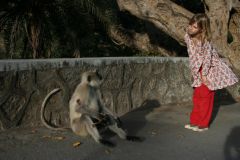
In India, animals share the streets with people. Men in turbans kick smelly dogs, buffalos wander the streets with their calves, women in sarees feed leftover lentils and rice to street dogs, and carrots and chapatti to the holy cows. Elephants with gray, wrinkly skin take their time walking down the streets, camels pull carts full of cow dung, holy cows roam the streets, peddlers whack the holy cows to get away from their fruit stand, and dogs steal food. I’ve only seen 3 pet dogs the entire time I have been in India (2½ months). The rest of the dogs are stray. A toddler throws a stone at a dog. The dog barks and the child runs away.

From The Big Field Trip – India, December, 2009

People in India wear colorful clothes and shiny jewelry, bindis, sarees, anklets, and bangles. Men wear turbans, or Muslim prayer caps. Sarees are decorative cloth that married women wrap around themselves. My mom bought a beautiful rusty-red saree. Last night was the first time she has ever worn it. She hired a tailor to sew a petticoat and blouse to wear under it. Women wear beautiful sarees even when they are shaping cow dung or spreading tar on the streets. Women also put red paint where their hair parts to show they are married. They also wear bindis, a dot of red or pink or a dot of jewelry, on their forehead. In the countryside, many women wear huge nose rings attached to their earring by a golden chain. Some men wear turbans. Turbans are long strips of cloth that men wind around their heads. Some are 9 meters long – that’s about 30 feet! Our driver, Bupinder Sing, wore a brown turban one day, a purple turban the next day, and a pink turban the day after that. When I walk down the streets of India, it reminds me of walking through a butterfly garden with splashes of color all around.

From The Big Field Trip – India, December, 2009

There are lots of dirty and smelly things on the streets of India; you’ve got to watch out where you step. There are a lot of trash-covered streets with dogs, cows, and beggars eating out of the trash or looking for something valuable. People throw their litter on the street. Shop owners are always sweeping in front of their shops with brooms made of dried grass that look like dog tails. The trash sometimes gets picked up, but is often swept into a pile and burned, even the plastic. The smell makes me feel sick. There are also a lot of open sewers full of milky-white water. Once I stepped in the sewer, and I had to take a shower. I had to shower my shoes too. There is cow dung everywhere on the streets. It’s good for many Indian people because they pick it up off the streets, shape it into discs, dry it, and burn it with firewood in a small oven for cooking. It’s bad for me because I step in it so often, even though Indian people say that it is good luck.

From The Big Field Trip – India, January, 2010

Most of the streets are full of traffic. The engines roar and horns beep. Gray smoke comes out of tailpipes. People cover their faces with shirts, sarees, or handkerchiefs. In India there are a lot of auto rickshaws. They are called took-tooks because they make the sound “took-took”. Took-tooks have three wheels. The larger public took-tooks can seat seven passengers comfortably, or twenty-two with people shoved in, sitting on laps, sitting on the floor, and hanging off the sides. On the city busses I have seen people sitting with the luggage on the roof. Took-tooks, busses, cars, and trucks are zooming through the streets, dodging cows. People dodge the vehicles. Watch-out, you may get hit! Vehicles never stop for people – only for cows. If you have to cross a busy street, I suggest that you have an Indian person or a holy cow cross with you.

From The Big Field Trip – India, December, 2009

In India the poorest people are worse off than poor people in the USA, especially the children. Many poor kids have no homes and some are so dirty that they are sick all the time. Poor children don’t grow as tall as healthy children because they don’t eat enough nutritious food. Some also use drugs like alcohol and white-out to make them feel better. This also keeps them from growing tall and healthy. Many kids have to work to earn money for their families. Poor children work in the fields, sweep the streets, look in the garbage for something valuable or food, work in factories, or beg for money. Sometimes the father is drunk so he uses all the money on alcohol. Some poor kids run away from home to escape poverty and make money for themselves.

From The Big Field Trip – India, December, 2009

On the streets of India I see a child with brown dust in his knotty, black hair. He is begging with a short old woman with gray hair, who puts her hand to her toothless mouth repeatedly to show that she needs money for food. A naked girl with wood chips in her hair stands in front of the tent where her family lives. The tent is on the sidewalk of a busy road; it is made of sheets of thick plastic and bamboo sticks. Beside the tent, a man carves a cricket bat to sell to passersby. A cricket field is full of boys playing cricket. A boy hurls a red ball into the dusty ground. The ball bounces. The batter hits the ball with a cricket bat. The boys tell their mothers that they go to school, but they play cricket instead. An old woman prays to an orange god at a shrine on the side of the street. Her hands are together and she is on her knees. She ignores the sounds of the street; her eyes are closed and she doesn’t stir. A small baby at her side sleeps in a torn blanket.

I’ve never been to another place like India. Just walking down any street in India makes my senses feel like they are going to burst. When I walk down the streets of India, I feel like home is half a world away.

Tags:   · · · · 1 Comment

Indian Food

February 5th, 2010 by Cyrus
Respond

Indian food has always been one of my favorite foods. It has always been a special treat for me. It is very flavorful and spicy. Indian food has many different varieties, North Indian food and South Indian food differ greatly. Indian food is delicious.

Some things in the north and south of India are the same. The main staples in all of India are dal, lentlils, and rice. Indian food has lots of spices. Indian food uses turmeric, cardamom, cumin, ginger, red chili powder, black pepper, coriander, fresh green chilis, cloves, and garlic. Most of Indians are vegetarian, so almost every Indian dish has vegetables. It uses potatoes, cauliflower, chilis, spinach, peas, onions, carrots, squash, tomatoes, eggplant and okra. Pinkie, from our host family, made a really good dish from okra yesterday. It was fried okra seasoned with loads of spices – simple, yet tasty.

From The Big Field Trip – India, December, 2009

In every culture, cuisine is influenced by the traditions of the people and the climate the food is grown in. For example, no Hindus eat beef as cows are sacred. In North India where it is cold and dry, wheat is the main grain. In South India, where it is hot and moist, rice is the main grain. Also, in the South, they use coconut oil to fry their food. In the North, they use mustard oil. When I leave a North Indian restaurant, I feel like I’ll never eat again, because the food is so rich. When I leave a South Indian restaurant, I feel like my mouth is on fire. South Indian food is less rich than in the North, but it’s much more simple. North and South Indian food are very different, even though they are the same country.

From The Big Field Trip – India, December, 2009

I have had a lot more North Indian food than South Indian food because we live in Rajasthan, which is in the north. Gee is very popular in the North. Gee is clarified butter. It is added to Indian food to make it rich. Most Indians in the north eat food with their hands and/or chapatti. Chapati is a simple tortilla like bread, used as a spoon. Some popular North Indians foods are palak paneer (spinach cheese) and aloo gobi (potato cauliflower). Most people in India are vegetarians, but some eat meat. Since Hindus consider cows holy, and there are many Muslims in India, beef and pork is not eaten. Indian meat dishes have either chicken, mutton, or fish in them. My favorite meat dish is tandori chicken, which is baked in a special oven called a tandoor.

Indian food is delicious. From palak paneer to dal, Indian food is rich and spicy. Indian food can differ from north to south, but all of it makes my mouth water. I like Indian food, but I think I’ve had too much. When ever I go to a restaurant, I order fried chicken. I’m tired of rich food.

From The Big Field Trip – India, January, 2010


Chapati recipe (serves 5)

Ingredients:

3 c. Flour

2 t. Salt

2 c. Water

Directions:

  1. Mix the flour and the salt in a large flat bottomed mixing bowl.
  2. Slowly add the two cups of water to the mix kneading all the time.
  3. Break the dough into small balls, about the size of golf balls.
  4. With a rolling pin roll the balls one at a time into thin circles about 8 in. in diameter.
  5. In a frying brown the chapattis on both sides, then put them over the direct flame until they puff up. Be careful not to burn them.
  6. Serve hot with any North Indian dish.

Tags:   · · 1 Comment